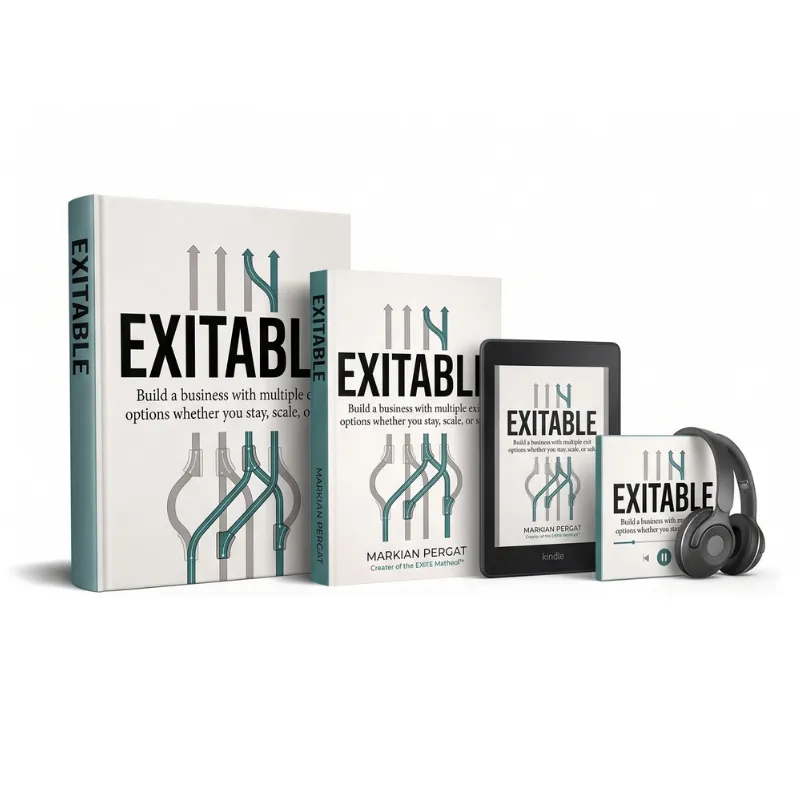
Build a Business That Gives You Options
Make your business more valuable, transferable, and less dependent on you, whether you stay, scale, partner, or sell.
Limited to eight advisory clients at a time.
You built a successful business, but how much does the business actually depend on you?
You may have a profitable company, loyal customers, and a good team.
But perhaps too many decisions still come back to you.
Maybe you're the person everyone calls when something goes wrong.
Maybe the business would struggle if you stepped away for six months.
Maybe you're considering selling, but you're not sure what a buyer would actually be buying.
Or maybe you don't want to sell at all. You simply want more freedom, more value, and more choices about what comes next.
That's what exitability is about.
You don't need to be preparing to sell.
You need to build a business that gives you options.
What I Help Business Owners Do
The work isn't about following a generic business-improvement checklist.
It's about identifying what is limiting the value, independence, transferability, or options of your particular business, and deciding what is actually worth fixing.
Get out of the middle
Reduce the degree to which the business depends on you for decisions, relationships, problem-solving, and day-to-day operations.
Make the business transferable
Build systems, people, processes, and knowledge that allow the business to produce results without everything running through the owner.
Create more value
Identify the levers that can make the business more valuable, not simply bigger.
Build independence
Create a business that can operate and perform without requiring the owner to be at the centre of everything.
Create more options
Get clearer about what comes next: stay, scale, bring in a partner, take some money off the table, transition to a new role, or eventually sell.
The goal isn't to choose your exit today.
The goal is to make more choices possible when the time comes.
This is for Established Business Owners
This advisory is designed for owners who have already built something real.
You don't need another course on how to start a business.
You're more likely to recognize yourself in one of these situations:
You're successful, but too involved
The business works, but too much of it still works because of you.
You're thinking about what's next
You don't necessarily want to sell. You just know you don't want to keep doing things exactly the way you've been doing them.
You're considering a sale
You want to understand whether the business is actually ready, what could make it more valuable, and what a buyer would see.
You want to grow
You're considering organic growth, acquisition, partnership, or another path—but want to understand the implications before committing.
You want more freedom
The business provides income, but it's still consuming too much of your time, attention, or decision-making capacity.
You don't have to know exactly what you want your eventual exit to look like.
That's part of the work.
My Approach
Most business advice starts with a plan.
I start with a diagnosis.
Before deciding what you should do, we look at where your business actually stands and where the biggest constraints and opportunities are.
The work is grounded in the EXITS Method™: five dimensions that influence a business's ability to create value and give its owner options.
Emotional Maturity
Your relationship with ownership, purpose, and what comes next.
X-Factor
The factors that make the business meaningfully valuable and differentiated.
Independence
How well the business can operate without you.
Transferability
How easily the value and results of the business can be transferred to someone else.
Strategy
The pathways available to you, and the choices that create or eliminate those options.
You don't need to become an expert in the framework.
I use it to help you see your business more clearly.
How the Advisory Works
Most business advice starts with a plan.
01 - Start with a conversation
We begin with a conversation about your business, where you are today, and what you're trying to accomplish.
There is no need to arrive with a five-year plan. Just your most pressing challenge or constraint.
02 - Complete the Exitability Diagnostic
If it makes sense to go further, you'll complete a deeper assessment of your business across the five dimensions of exitability.
The purpose isn't to give you a meaningless score.
It's to identify where your business is strong, where it may be constrained, and where the biggest opportunities may lie.
03 - Review the business together
We review the diagnostic together and identify the issues that actually matter.
Not everything needs fixing.
The objective is to determine what deserves your attention first.
04 - Decide whether we should work together
If there is a meaningful opportunity to improve the business and the fit is right, we determine what an advisory engagement would look like.
If not, you still leave the conversation with greater clarity about your situation.
Exitability Advisory
A focused advisory engagement for established business owners.
This is 1:1 advisory work. Not a course, group coaching program, or collection of recorded lessons.
Over 90 days, we'll work through the highest-priority opportunities identified in your business.
The engagement includes:
Two advisory conversations each month
Focused conversations around the decisions, problems, and opportunities that matter most.
A diagnostic-driven approach
The work starts with understanding your business rather than prescribing a generic plan.
Prioritized strategic guidance
We identify what matters most and help you determine what to do about it.
Frameworks and exercises
Practical tools you can use to think through decisions and make changes inside the business.
Between-session support
Questions and issues don't always arrive on a convenient schedule. The engagement includes access for the strategic questions that arise between conversations.
Focused work
Enough time to move beyond diagnosis and begin making meaningful changes, without pretending that every business can be transformed in three months.
What Makes This Different
It's not about preparing your business for a sale.
A sale is only one possible outcome.
The objective is to build a business that works better for you today and gives you more choices tomorrow.
It's not a generic business coaching program.
We aren't starting with a predetermined curriculum.
The business determines where we focus.
It's not about making a bigger business at any cost.
More revenue doesn't automatically mean more value.
Growth that creates more owner dependence can make a business less attractive, not more.
It's not about creating a perfect five-year plan.
Your circumstances will change.
The goal is to improve the quality of the options available to you.
What This Looks Like in Practice
Every engagement is different because every business has different constraints.
One owner may need to reduce their dependence on the business.
Another may need to determine whether an acquisition actually makes sense.
Another may need to resolve a partnership and establish a fair path forward.
Another may need to understand what would make the business more attractive to a future buyer.
Another may simply need to step back and determine what they actually want from the business they've spent years building.
The work starts with the business in front of us.
About Markian
I've been on the other side of this problem.
I once tried to sell my own business.
A business broker told me it wasn't really sellable in its current state. Too much depended on me. The systems weren't there. A buyer would essentially have to take on the same job I was doing.
That was a difficult thing to hear.
It also changed how I thought about owning a business.
I stopped asking only how I could make the business perform better and started asking a different question:
Does this make the business more valuable, transferable, and independent of me?
Over the following years, I rebuilt the business around that question.
Eventually, I had something very different: a business that could operate without me.
The irony was that once I had created the ability to leave, I didn't necessarily want to.
I had options.
That's the idea behind exitability, and the reason I now help other owners build businesses that give them the same kind of optionality.
You don't need to know your exit
You need to build a business that gives you choices.
Stay.
Scale.
Partner.
Sell.
Or simply step back and let the business become something that doesn't require you every day.
That's the work.
Register your interest
I'm currently building the next group of 1:1 advisory relationships and keeping the number of clients intentionally limited.
Register your interest and I'll follow up to learn more about your business, what you're trying to accomplish, and whether the advisory is a fit.
No obligation. No automated sales sequence. Just a conversation.
FAQ
Do I need to be planning to sell my business?
No. Exitability isn't synonymous with selling. The objective is to build a business that gives you more options, whether you eventually stay, scale, partner, or sell.
What size businesses do you work with?
The advisory is designed primarily for established owner-led businesses with a meaningful operating history, an established team, and enough complexity that owner dependence, transferability, or strategic decisions have become significant issues.
This typically means a business doing $1M-$10M in revenue, with at least 6 employees, and been in business for 8+ years.
Is this consulting or coaching?
It's strategic advisory with a focus on exitability. We work on the business, the decisions you're facing, and the opportunities that can improve its value, independence, transferability, and options.
How long is the engagement?
It depends on the scope of the issue we're working through. An initial engagement might be 90 days, or it might longer. After the target outcome is achieved, and there is more work to do, and it makes sense for both sides, we can continue from there.
How do I know if we're a fit?
We start with a conversation or diagnostic. I'll look at where your business is today, what you're trying to accomplish, and whether I can genuinely add value. If I can't, I'll be the first to mention it.
TD;DR
I help established business owners build businesses that are more valuable, transferable, and less dependent on them.
You don't need to be preparing to sell.
The goal is to give yourself more options for what comes next: stay, scale, partner, or sell.
1:1 Strategic Advisory
We'll work together closely around the issues that matter most to your business, from owner dependence, to value creation, and your options for what comes next.
This is a focused, hands-on advisory relationship rather than a course, coaching program, or collection of generic advice.
The first step is a conversation to understand your business. If it looks like there's a fit, we'll discuss what working together could look like, including the scope, timeframe, and investment.